Conversion more than doubled in two months
Česká spořitelna ran the Empower coaching programme with more than 600 bankers. The business numbers went up, the bankers reached for the tool, and the bank's own educators found it easy to run. It is now scaling to the entire retail network of 2,800+.

Twice as many clients said yes.
For three months, bankers worked with the coach on one thing: how to run a better investment meeting. At the start, about 17 out of every 100 meetings ended with the client investing. By month three, it was 43.
Same bankers, same clients. The difference was the conversation. Two months in, the bank decided to give the programme to all 2,800 bankers in its retail network.
Enterprise software the employees actually love.
The benefit is big, and not just that the client says yes to investing. It gives the banker enormous self-confidence and certainty. If you get it wrong five times with the agent, nothing happens. It just teaches you.
We have one coach for the whole region, so he hasn't much time for us, physically we just can't get to him. The agent lends us that coaching capacity. It has to be seen that way, because otherwise the information simply never reaches us.
It's the best training simulator I've ever had.
The meeting that carries the margin is the one bankers avoid.
Investment products are one of the bank's largest growth opportunities, and they open with a conversation most bankers would rather not start. Every meeting that stays on current accounts and mortgages is margin the bank never books, across hundreds of branches, every working day.
Simulation-based training was a step forward from static eLearning. But a simulation forgets you the moment you close it. It cannot connect practice to the meeting you have at two o'clock, and it cannot carry you past week three.
From transaction to advice
A retail banker used to process a product. The job now is to hold an advisory conversation and be trusted in it. That is a different skill, and it is behavioural: bankers know what a good investment conversation contains and still steer away from having one.
One banker, four generations
How you open an investment conversation with someone in their sixties who has never held a fund is not how you open it with a twenty-five-year-old who already holds crypto and has read more than you have. Same banker, same day, opposite register.
Coaching that cannot scale by hiring
Behaviour changes by repetition against someone who reacts, not by reading. One human coach covers an entire region, so most bankers get feedback rarely and rehearse never.
Enablement nobody opens
The bank already owned a sales-enablement tool. It delivered small uplift for heavy deployment effort, and rewarded memorising set answers, so bankers treated it as a percentage to hit rather than a way to get better.
The bank tested us on half a million of its customers before it tested us on its bankers.
Since 2023, Promethist has been Česká spořitelna's AI partner. It started on the customer side, with a fraud-awareness digital human inside the bank's George app that reached over half a million people and held their attention long enough to change what they knew about fraud.
With that proven, the bank pointed the same capability at its own people: the bankers who sit across the desk from those customers every day.
Read the fraud-awareness story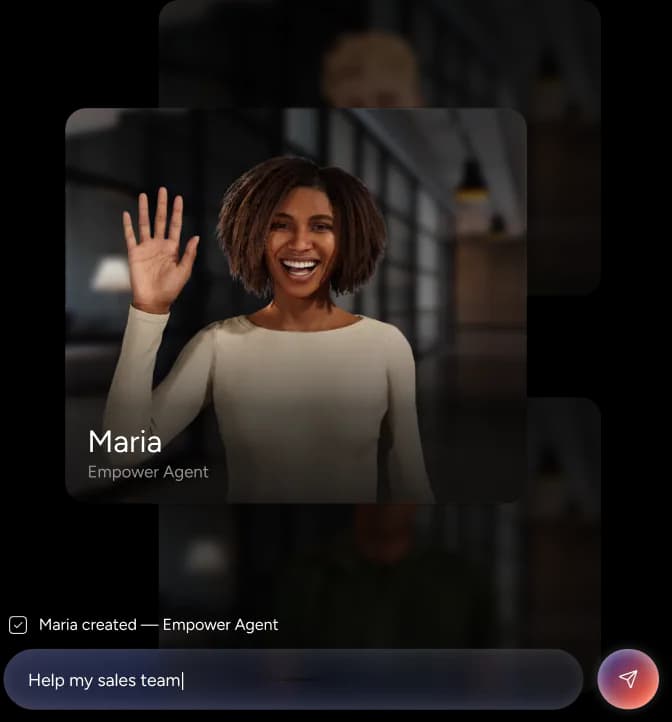
One session, and the next one starts sharper.
Empower is not a training tool with an AI layer on top. Two agents work in alternation: the Empower Agent, which carries a banker's development across months, and the role-play simulations, which stand in for the clients that banker meets. One decides what to work on, the other is where the repetition happens.
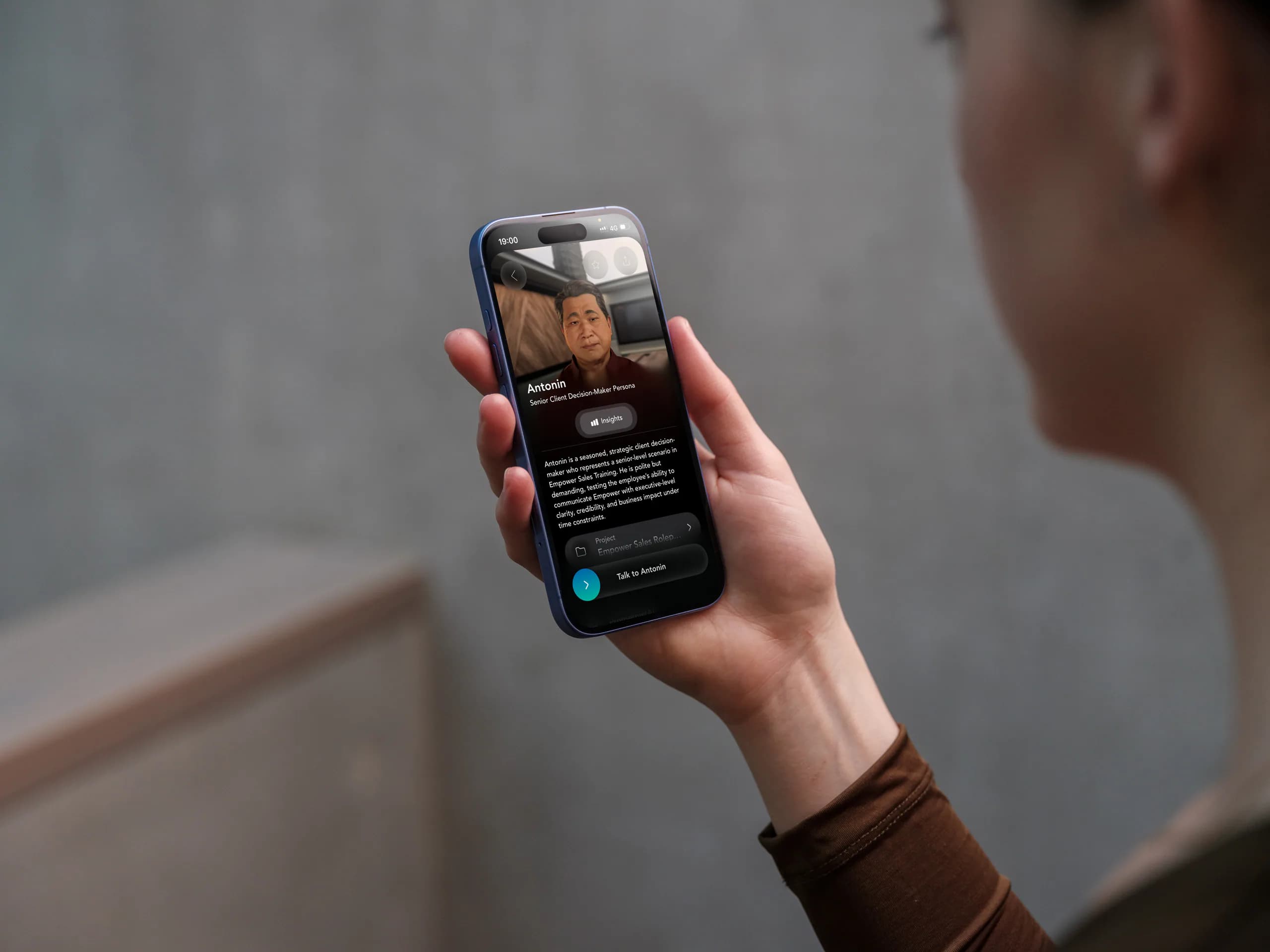
Spoken, not typed. The banker rehearses the conversation out loud, exactly as they would hold it.


Bankers who get measurably better, month after month.
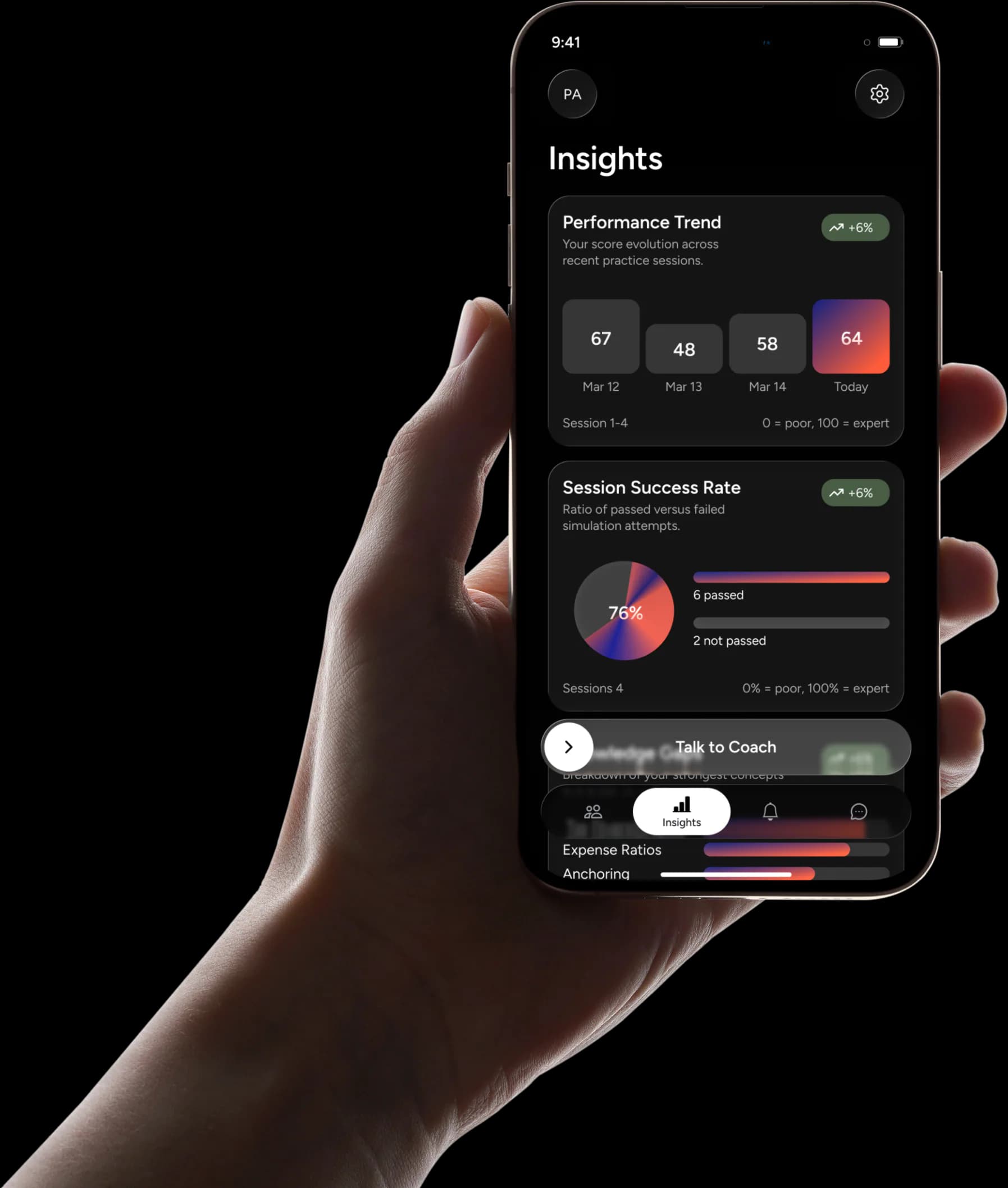
Four layers, one behavioral model. Each stands on its own and each is part of one platform, unified by the Relational Intelligence Engine that accumulates behavioral signal across every coaching conversation, every simulation, and every meeting a banker walks into. The longer it runs, the more it knows, and the better it coaches.
Adaptive Sales Academy and Coaching
The development path the bank actually ran: consultative advisory, discovery, objection handling, and holding the register across four generations of client. Every module produces behavioral signal about one banker rather than a completion tick.

Simulation and Reflection Engine
Stand-ins for the clients on a banker's own list, across the generational range described above, and they push back rather than accept the first answer. The system remembers the last session, names the gap, and calibrates the next one. Getting it wrong five times costs nothing.
Performance Companion
The ten or fifteen minutes before a real client meeting: what this client will resist, the angle in, the phrase that opens the conversation. Then the written reflection afterwards. Instead of walking over to ask a manager, the banker gets preparation for that specific conversation on the spot.
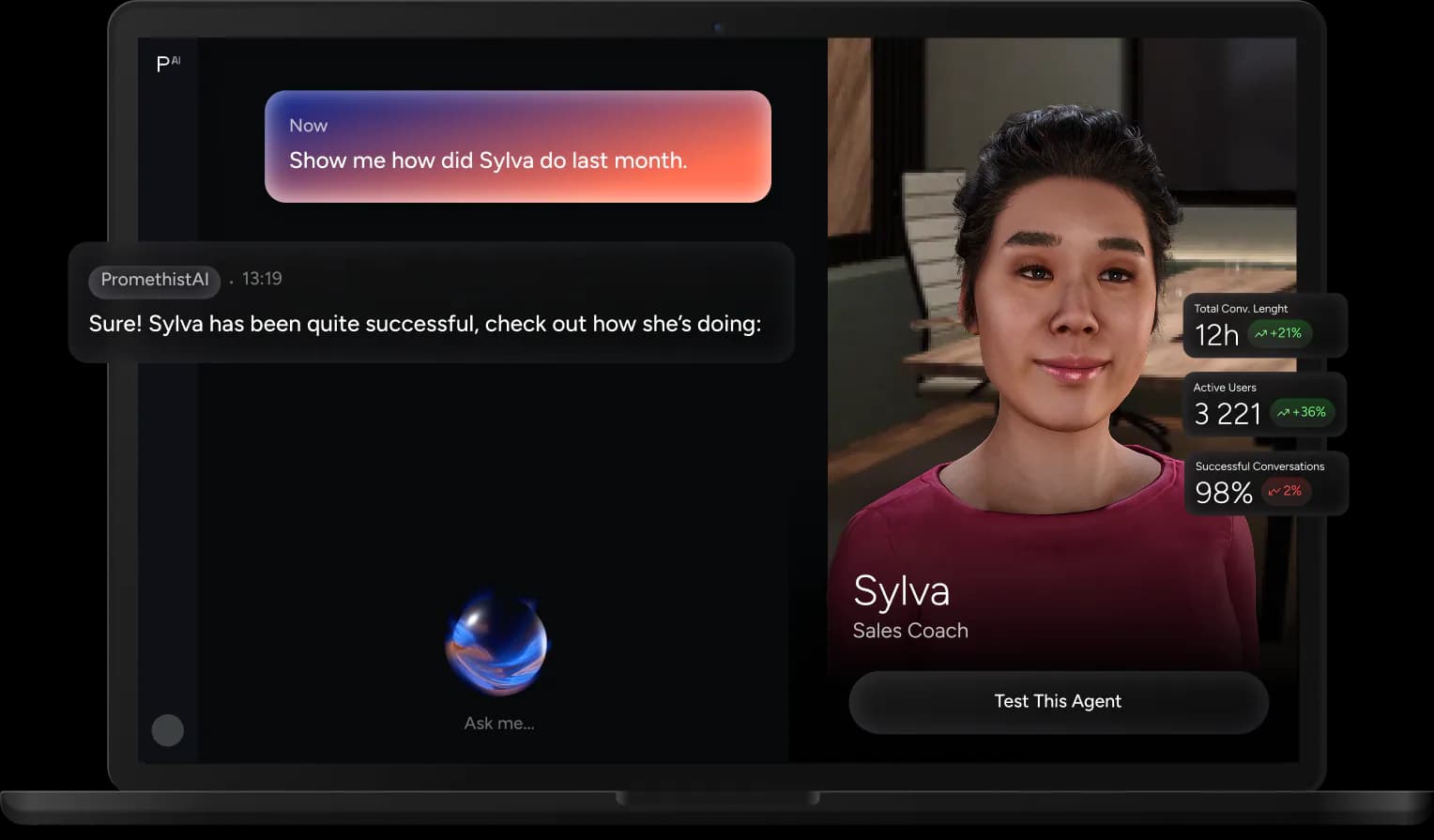
Relational Intelligence
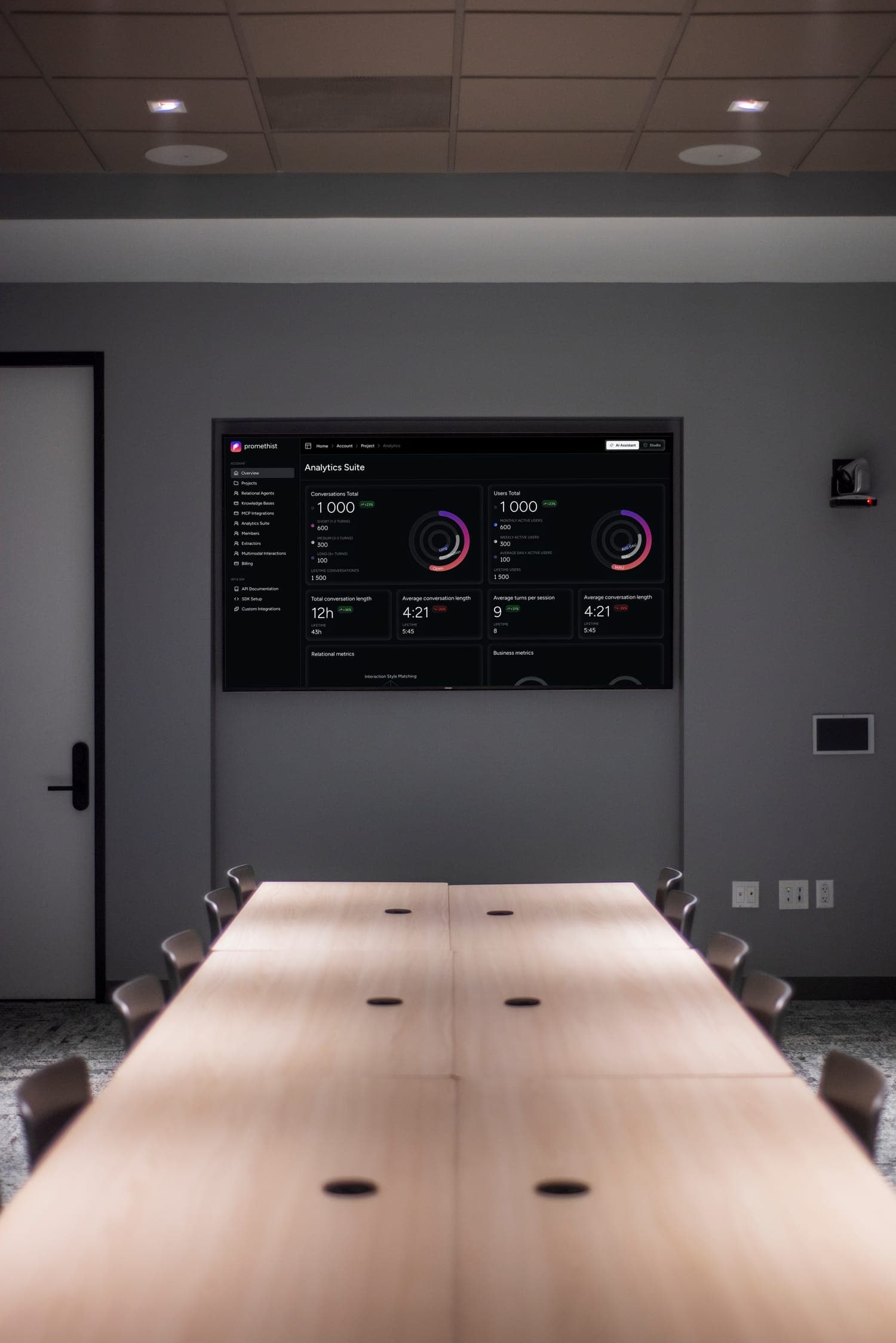
Topic analysis across the whole network: which conversations bankers steer away from, where capability is thin by region, what no performance review surfaces. The model persists through turnover, so institutional knowledge stops leaving with the person who held it.
Bankers rate it higher than anything they were handed before.
The bank asked the people using it every day. Nine in ten rated it positively, and the reasons they gave were about their own development rather than a target to hit.
The reception, from the people using it every day.
- 92%
- Rated it positively overall
- 96%
- Feel in control of which skills they choose to develop
- 76%
- Value having the coach on their work phone
I open the coach before almost every meeting, ten, fifteen minutes. I give it what I already know about the client, and it hands me the angle, the phrases, the way in. That speed is exactly what I need.
The bank ran us against the market standard, in its own branches.
The first phases were built to answer one question: does the coaching layer deliver more than the role-play tools the market already sells? Running both formats as a deliberate internal comparison answered it from inside the branches.
Phase 1A: Coaching
The full Empower solution: a persistent Relational Agent combined with simulated clients. Established that the coaching layer delivers meaningfully more than simulation alone.
Phase 1B: The control
Simulation only, with the coaching layer switched off. This was what the market already sells, running in the same network at the same time.
Phase 2: Crossover
The control group moved onto the full Empower Agent. Having worked in both, they were the only people who could say which was better. They stayed on the coaching version.
The coach told the bank what its bankers actually needed.
One of the most valuable outputs was what emerged from analysing the topics bankers raised with their Empower agent. Questions about communicating with older, conservative clients significantly outnumbered questions about younger ones, directly contradicting the project's initial focus.
Bankers speak more openly in a private, low-stakes interaction with an Empower agent than they would in a survey or performance review. That candour gave the bank's learning and development team a window into the real concerns of their workforce that they had never had before.
Adoption was managed, not hoped for
This did not spread by enthusiasm alone. The bank named an owner, took a regular read on who had started and who had not, and pushed for coverage across the floor. Software this far inside the working day gets used because somebody senior decided it would be.
More realistic than anything before
Bankers who had used simulation tools before reported the simulated clients felt markedly more realistic. The experienced ones asked for harder profiles, which the next phase added.

She had a client who insisted there was money left over at the end of every month, and somehow nothing to show for it. She wasn't sure how to handle it, and admits she wouldn't have been bold enough to push. The coach told her to ask him outright: where does it actually go? So she did. He stayed completely relaxed, and she followed with the question the coach had teed up: could he picture setting some of it aside for the future, not just for right now?
Now I ask that question on my own. I don't need the coach in my ear to do it anymore.
Every other platform resets with every session. This one compounded.
The bank had bought sales enablement before. The problem was never the content: it was episodic development, the assumption that a module, a one-time role-play or a quarterly coaching conversation is enough, and that a banker is the same person next quarter.
- Resets with every session, no memory of the last one
- Content delivery with a feedback overlay on top
- Rewards memorising the set answer
- Score-based measurement, bounded by the session
- Value stays flat however long it runs
- Persistent: knows this banker across months, not minutes
- A behavioral model that acts, not just informs
- Coaching attached to the meeting they have next, not to a calendar
- Longitudinal measurement, against conversion and contract value
- Value compounds the longer it runs
Time horizon
Episodic tools optimise for the session. This was judged on what conversion and contract value did across a cohort over months.
Mechanism
Not a content library with AI on top. A model that finds the weak spot a banker cannot name and works on that one.
Compounding economics
Every month the coaching ran, it knew each banker better. The incumbent tool started from zero every time it was opened, which is why bankers stopped opening it.
From a standing start to three hundred sessions a month.
Month one is a genuine zero: nobody had opened it yet. Two months later the programme was running close to three hundred coaching conversations a month.
That is worth being straight about. It did not spread on enthusiasm alone. The bank put a name against it, took a regular read on who had started and who had not, and pushed for coverage across the floor. Software this far inside the working day gets used because somebody senior decided it would be, and the interviews are what tell you whether people resented it.
A regulated bank, a distributed network, and a commercial bar to clear.
A regulated European bank ran us beside the sales-enablement tool it already owned, in its own branches, and judged the result on branch margin rather than on how the training was received.
In production inside a regulated bank
Not a sandbox or an innovation-lab rollout. Live in Česká spořitelna, part of Erste Group, 5M+ clients across 7 countries, for three years and counting.
Cleared for the whole network
After 600+ bankers, the bank decided to take the programme to its entire retail network of 2,800+. That decision is the strongest read on the result, because the bank made it with the numbers in front of it.
Nothing to roll out
No new hardware, no desk-only client, nothing added to the IT roadmap. It runs on the phone the banker already carries, which is why adoption did not need a change-management programme behind it.
Segment-aware coaching
Premier and mass-market bankers are judged on different criteria and hold different conversations. The Empower Agent distinguishes them rather than averaging everyone into one script.
It won a straight fight
An established sales-enablement tool ran alongside it. Bankers moved onto this one and said so in the interviews, which is not how enablement software usually gets talked about.
The bank's own educators run it
The people who deliver training inside the bank find the tool easy to work with, which is what decides whether a programme survives contact with an L&D calendar.
They walk into real client meetings more confident.
- 87%
- Say the analysis of their mistakes tells them what to do better next time
- 78%
- Got clearer on their own strengths and weak spots
- 70%
- Feel more confident in real client meetings
It gives the whole conversation a structure, so I know exactly where I'm taking the meeting. It settles me, takes the pressure off, and I walk in more confident in front of the client.
The same pattern runs in any business that sells through conversations.
A distributed frontline, a conversation that carries the revenue, and coaching capacity that lives in a handful of people who have no time. Change the products and the sentence still holds.
Reps and clinicians in the same bind
A medical science liaison holds a technical conversation under scrutiny, with a listener who knows the field. The knowledge exists; the conversation is the constraint.
See the fitRamp is the whole problem
High turnover, a product that changes quarterly, and quota carried by people who joined last month. Coaching capacity per rep is the ceiling on how fast a team ramps.
See the fitTrusted advisor, without the ten-year ramp
Juniors are billed out on the strength of a conversation they have not had enough of yet, and the partners who could coach them are the ones with no time.
See the fitYour bankers are already in the meeting. Give them a coach who walks in with them.
One coach can reach a handful of people a week. A coach on every banker's phone reaches all of them, before the meeting that matters. This started with one group of bankers and one number worth moving.
Other enterprises we serve in production.
 Banking · Customers
Teaching half a million customers to spot the scam
A fraud-awareness digital human inside the bank's own app, which turns on the customer mid-lesson and runs a textbook scam to find out whether the lesson landed.
- 88% caught a live simulated scam
- 4.8 min average conversation, inside a banking app
 Banking · Branch of the future
An AI concierge reimagining the retail branch
A relational digital human greets every visitor at the bank's Future Lab in Prague, open non-stop, as the first point of contact in the branch.
- Engaging multi-lingual customer service
- Sets a new standard for the branch of the future
 Telco
TelcoScaling B2B sales and customer care
Personal, proactive care-to-sales experiences for a multinational telco's enterprise customers, without increasing headcount.
- +97% of interactions addressed customer needs
- +92% of B2B customers found Relational Agents valuable